Skip to content

Main Navigation

ICLD
  • Home
  • Online courses
  • My Page
  • Login
  • Home
  • Online courses
  • ICLD core course

Participatory democracy in local governance

Curriculum

  • 4 Sections
  • 33 Lessons
  • 2 Days
Expand all sectionsCollapse all sections
  • Module 1. Overview
    7
    • 1.1
      What is participatory democracy?
    • 1.2
      Why participatory democracy?
    • 1.3
      Participatory vs deliberative democracy
    • 1.4
      Ladder of participation
    • 1.5
      EXAMPLE of participatory democracy principles: Eurocities
    • 1.6
      Best practices: IOPD participatory democracy experiences around the world
    • 1.7
      Module reflection and facilitation
  • Module 2. A bit of history and context
    5
    • 2.1
      Background
    • 2.2
      Participatory democracy in Sweden
    • 2.3
      Participatory democracy in Latin America
    • 2.4
      Co-creation of participatory mechanisms
    • 2.5
      Module reflection and facilitation
  • Module 3. Methods and forms of participatory democracy
    18
    • 3.1
      Overview of the methods
    • 3.2
      Hackathons
    • 3.3
      Backcasting
    • 3.4
      Open Space
    • 3.5
      Community researchers
    • 3.6
      Crowdsourcing
    • 3.7
      Hearings
    • 3.8
      Focus groups
    • 3.9
      Scenarios
    • 3.10
      Citizens’ Assembly
    • 3.11
      Community-based Participatory Research (CBPR)
    • 3.12
      Participatory budgeting
    • 3.13
      Citizen Juries
    • 3.14
      (e)Petitions
    • 3.15
      Digital Platforms
    • 3.16
      Citizen Report Cards
    • 3.17
      Living Labs
    • 3.18
      Module reflection and facilitation
  • Module 4. Strengthening participatory democracy through your ICLD project
    3
    • 4.1
      Problem oriented project planning, PART 1
    • 4.2
      Problem oriented project planning, PART 2
    • 4.3
      How to strengthen peer-to-peer learning on participatory democracy in your municipal partnership or network

Module 2. A bit of history and context

Background

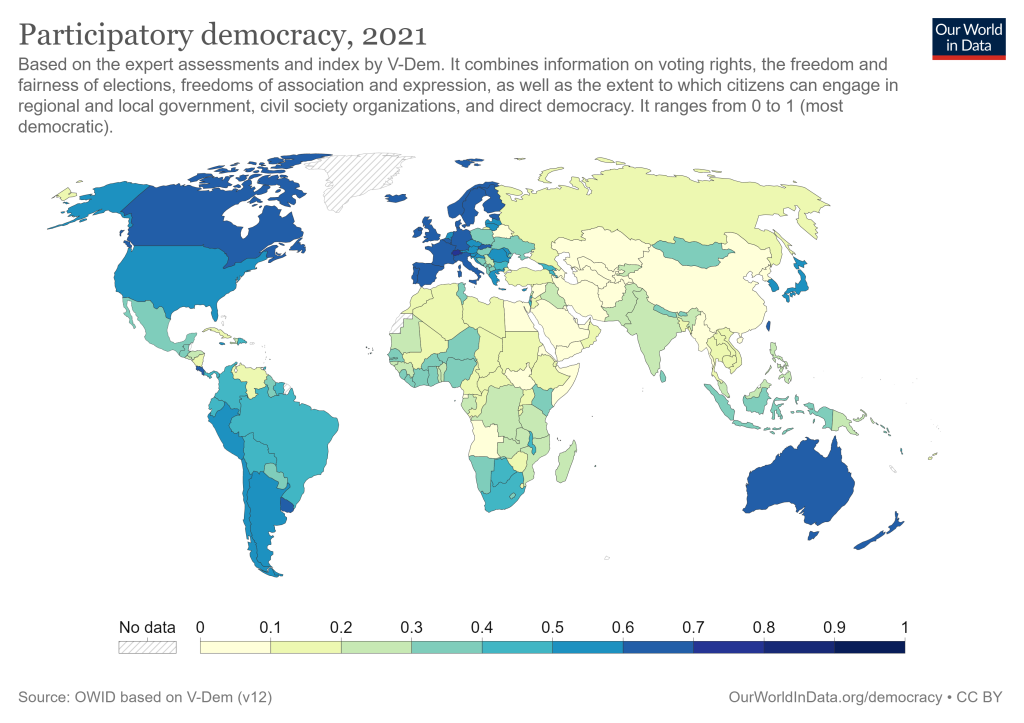
Since the 1960s, participatory discourses and techniques have been at the core of decision-making processes in a variety of sectors around the world – a phenomenon often referred to as the participatory turn. Over the years, this participatory turn has given birth to a large array of heterogeneous participatory practices developed by a wide variety of organizations and groups, as well as by governments. Among the best-known practices of citizen participation are participatory budgeting, citizen councils, public consultations, etc. However, these experiences today are sometimes far from the original 1960s’ radical conception of participatory democracy, which had a transformative dimension and aimed to overcome unequal relationships between the state and society and emancipate and empower citizens in their daily lives.
Module reflection and facilitation
Prev
Participatory democracy in Sweden
Next
Proudly powered by WordPress | Theme by: WP_Byrån.
Cookies
We serve cookies. If you think that's ok, just click "Accept all". You can also choose what kind of cookies you want by clicking "Settings". Read our cookie policy
Settings Accept all
Cookies
Choose what kind of cookies to accept. Your choice will be saved for one year. Read our cookie policy
  • Necessary
    These cookies are not optional. They are needed for the website to function.
  • Statistics
    In order for us to improve the website's functionality and structure, based on how the website is used.
  • Experience
    In order for our website to perform as well as possible during your visit. If you refuse these cookies, some functionality will disappear from the website.
  • Marketing
    By sharing your interests and behavior as you visit our site, you increase the chance of seeing personalized content and offers.
Save Accept all