Module 3. Methods and forms of participatory democracy
Backcasting
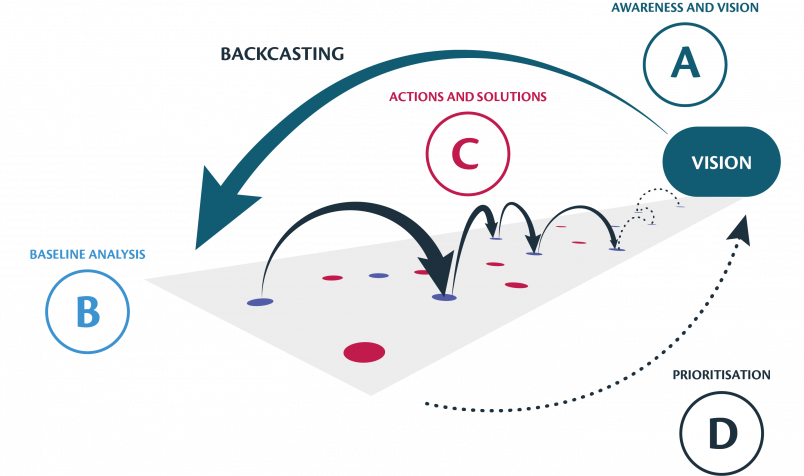
Backcasting is a planning method based on working backwards from an imagined future reality. Thereby, it differs from many other workshop techniques that are based on planning ahead from the present.
Description
Compared to many other techniques, Backcasting leads to more creative thinking and a greater sense of ownership among those involved in the process. Backcasting was developed in the 1980s and has been widely used in climate work around the world. The method is based on the question: “To achieve a certain goal in the future, what must we do practically today and going forward?”. Backcasting works particularly well where there are ready-made solutions and where the goal is ambitious and requires innovative options and new ideas. Unlike ‘forecasting’, backcasting is not about predicting the future, but about creating forward-looking work plans and exploring challenges.The first step is to determine the desired future. Then the participants work backwards in time step by step to determine what is required to achieve the future vision.
Used for
Backcasting is used to create a plan around a shared version of the future. It is not about trying to predict the future but more about predicting what conditions and prerequisites will be required to achieve a desired future.
Participants
Backcasting can take place in larger and smaller groups. It is important to include a broad group of participants in backcasting so that as many different perspectives and insights can be part of the process. If important knowledge is missing during backcasting, the result may be incomplete and of limited value.
Required resources
Backcasting can take place as a separate process or as part of a larger dialogue process. The costs are similar to those around other workshop formats.
Approximate time required
Backcasting can take place for a couple of hours. The results can often be better from a longer process where participants get more time for reflection. The actual creation process is only the first step. It is important to create time and space for the results to be used in practice.
Strengths
- Can create creative solutions to complex problems
- Increased sense of ownership of a plan
- Can help make challenges visible in situations that are difficult to understand
- Can help clarify uncertainties and raise questions that need to be explored further
Weaknesses
- The result is only as good as the perspectives that come in – if important groups and perspectives do not participate, the result may be incomplete
- It is important that backcasting discussions do not become too extravagant and disconnected from limitations and challenges.
- Those who are important for the implementation of the plan and the achievement of the goal must be involved in the process, as far as possible.