Module 2. A bit of history and context
Participatory democracy in Latin America
Background
Latin America has been a global leader in democratic innovation, with many countries in the region adopting participatory mechanisms that have improved the quality of democracy, increased citizen engagement, and reduced corruption. The history is rooted in the region’s struggles against authoritarian regimes and political exclusion during the 20th century. In response to these challenges, a growing number of social movements, grassroots organizations, and progressive political parties emerged that sought to promote greater citizen participation and accountability in decision-making processes.
Participatory Budgeting in Porto Alegre set a global precendence
One of the earliest examples of participatory democracy in Latin America is the Workers’ Party in Brazil, which began experimenting with participatory budgeting in Porto Alegre in 1989. Through a series of community meetings and assemblies, citizens proposed projects and priorities, which were then evaluated and voted on by the community. The Porto Alegre process has been credited with increasing citizen engagement in local government, reducing corruption, and improving the quality of life in the city. It has since been adopted by cities and regions around the world as a model for participatory democracy.
The process faced challenges to institutionalization at higher levels, for multiple reasons that are not unique to Brazil. Political elites were been reluctant to give up control over decision-making and resource allocation, and a lack of clear legal and institutional frameworks for participatory budgeting made it difficult to ensure the sustainability and effectiveness of the process. There have also been concerns about the scalability of the process. Despite these challenges, participatory budgeting and other innovative mechanisms have since gained traction in Latin America and all over the world.
Participatory innovation as a means and an end
LATINNO describes how, in recent years, “thousands of institutional designs have been created aiming to not only include more citizens in the political process, but also to make governments more responsive and institutions more accountable, in addition to strengthening the rule of law, and promoting social equality“. In investigating how these new forms of citizen participation, they highlight how citizen participation is both a means and an end to improving the quality of democracy.
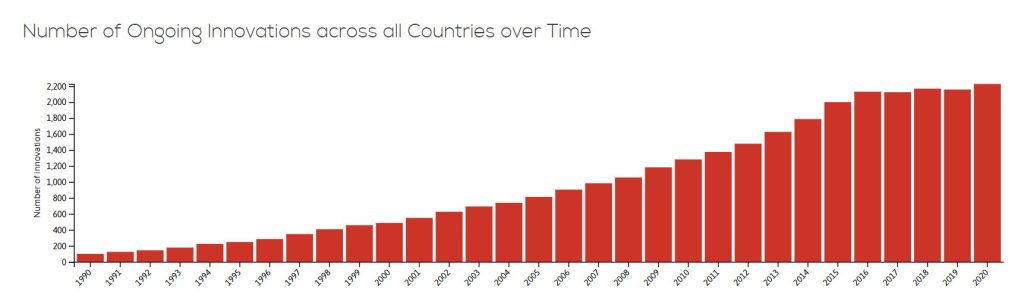
Participatory democracy innovations in 18 countries in Latin America. Data and visualization by Pogrebinschi, Thamy. (2017). LATINNO Dataset. Berlin: WZB.
Despite the challenges, many countries are adopting legal and institutional frameworks to support citizen participation. Important strategies include fostering collaborations and partnerships. Encouraging dialogue, building capacity and promoting transparency and accountability are other important features. New digital technologies can also enhance democratic innovation, by providing new platforms for citizen participation and increasing transparency and accountability in decision-making.
Networks of practitioners, scholars and politicians on participtory democracy are emerging globally. Some lessons from one collaborative learning experience are compiled in this ICLD policy brief: