Communicating Democracy and ICLD Core Values
Communicating Democracy through ICLD Core Values
The foundations of democracy are based on freedom of expression, freedom of the press, freedom of assembly, universal and equal suffrage, equality before the law and the principle of non-discrimination. ICLD’s core values are based on the foundations of well-functioning local democracy and are expressed under the following headings: equity, participation, transparency and accountability.

So how does these core values operationalise themselves within your projects?
Equity means that citizens must be treated in an inclusive and fair manner. All citizens should have equal opportunity to express their needs and be considered based on their different circumstances. Efforts to ensure that no discrimination or abuse occur, and that the needs of vulnerable groups are taken into account, with a particular focus on the position of women, are examples of measures that are seen as success factors.
Participation implies that local governments have a responsibility to actively promote a high level of participation in local decision-making processes concerning the design of public policies and services. Different approaches to increase citizens’ participation and influence in decision-making processes should be applied. Examples of steps in this direction are the development of instruments for increased dialogue, greater responsiveness and adaptation to civic needs.
Transparency in decision-making processes, planning and policy-making is crucial for citizens to be able to participate in local issues in a well-informed way, and for a socially sustainable local democracy. For citizens, increased transparency means that politicians and officials act in an open and predictable manner. Measures that ensure increased transparency, openness and predictability are therefore necessary in order to strengthen local democracy.
And for Accountability, there must be clarity in terms of power and responsibilities in a well-functioning democracy. There should also exist opportunities for sanctions and accountability. As it is not always possible for citizens to participate directly in decision-making, responsibilities must be made visible so that accountability can be demanded during ongoing processes, not just during elections. For the ICLD, signs that local governments are providing citizens with greater opportunities for accountability are when they’re making information available that shows how decisions are made, who is responsible, how citizens can appeal decisions and what the consequences are for misconduct.
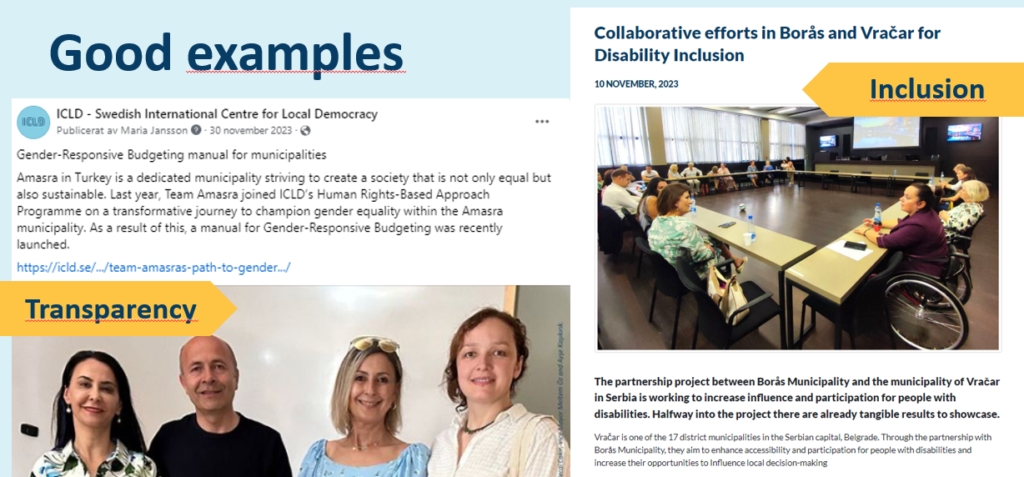
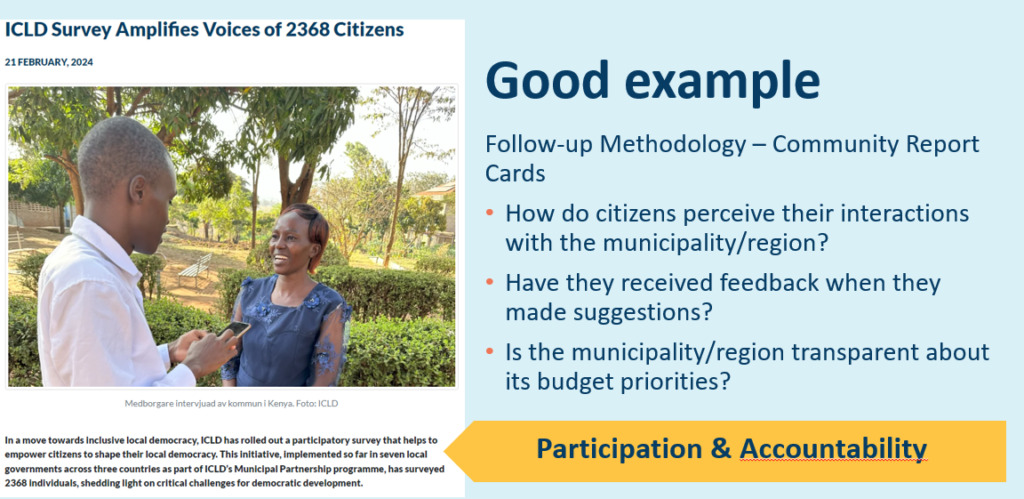
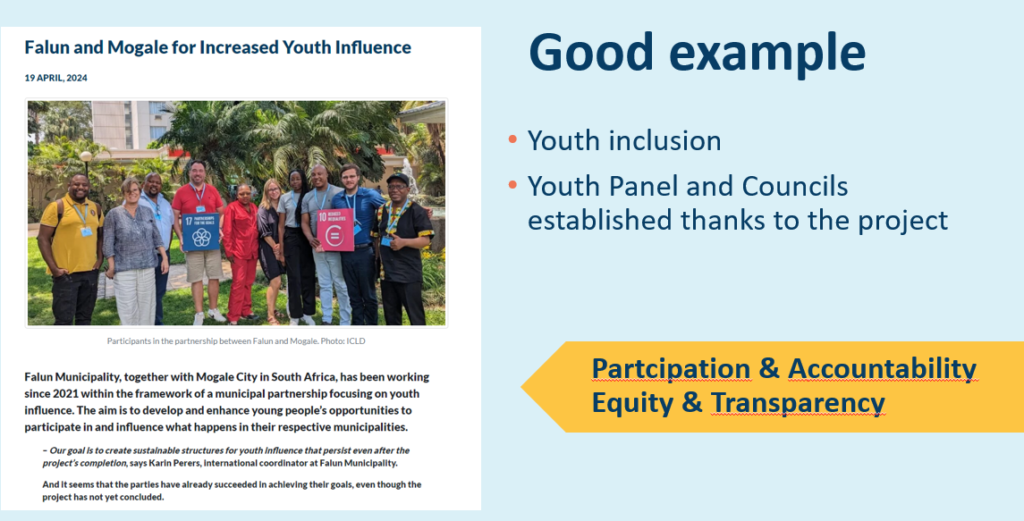
Some concrete examples of communicating democracy in social media through the core values:


Think about your project and how you could communicate democracy via the core values. Then, provide examples of how this could be accomplished.