Skip to content

Main Navigation

ICLD
  • Home
  • Online courses
  • My Page
  • Login
  • Home
  • Online courses
  • ICLD core course

Gender Equality in Local Governance

Curriculum

  • 4 Sections
  • 16 Lessons
  • 2 Days
Expand all sectionsCollapse all sections
  • Module 1: Introduction to Gender Equality
    The aim of this module is to introduce you the topic of gender equality, vital definitions and international frameworks that promote and defend gender equality.
    6
    • 1.1
      Introduction to Module 1
    • 1.2
      International frameworks that promote and defend gender equality
    • 1.3
      Key concepts: Gender equality and gender equity
    • 1.4
      Key concepts: Gender, sex and identity
    • 1.5
      Social norms, gender and intersectionality
    • 1.6
      Module Reflection and facilitation
  • Module 2: Equality for Women = Prosperity for all
    How can equality for women lead to a more prosperous society? In this module you will join ICLD Research Director Ana Maria Vargas and International Economist Antonio Lopez-Claros in four recorded sessions as they discuss the world of inequality and how whole societies change when promoting gender equality and women's empowerment.
    5
    • 2.1
      Introduction to Module 2
    • 2.2
      #GET1: The Virus of Violence
    • 2.3
      #GET2: From Classroom to Boardroom
    • 2.4
      #GET3: Women’s Economic Empowerment
    • 2.5
      #GET4: The Question of Culture
  • Module 3: Gender Mainstreaming - A Way to Achieve Gender Equality
    This module focuses on how you can use gender mainstreaming as a strategy to improve gender equality at the local level.
    4
    • 3.1
      Introduction to Module 3
    • 3.2
      The importance of gender disaggregated data
    • 3.3
      Gender budgeting
    • 3.4
      Tool: Gender mainstreaming draft proposals
  • Module 4: Gender Responsive Communication
    In this module we look at how communication can be used both to challenge and maintain gender inequality and social norms.
    1
    • 4.1
      10 Principles of Gender Responsive Communication

Module 1: Introduction to Gender Equality

Social norms, gender and intersectionality

What is a norm?

A norm can be described as a sort of socially constructed, unspoken or unwritten rule of behaviour that is expected and accepted in a particular socieity, culture or group. Norms are shaped and influenced by time, place and context.

Positive norms can help provide structure to society, and they can create a sense of belonging and understanding between people.

But norms can also be negative and debilitating. These norms can be oppressive, discriminatory, or restrictive, and they can create barriers for people to fully participate in society.

Norms usually only become visible when someone doesn’t fit into them.
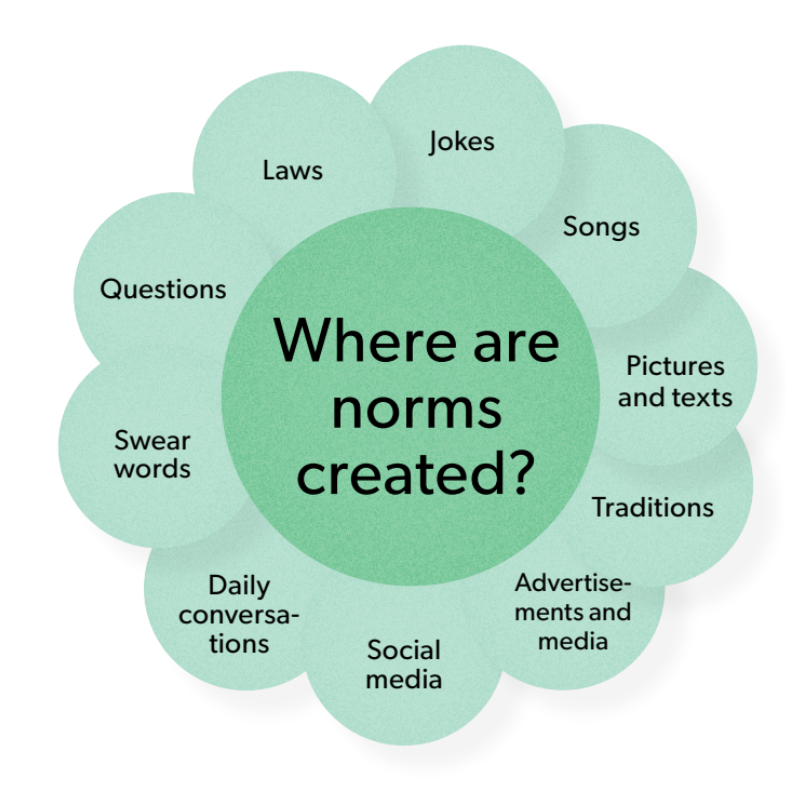
How are norms created?

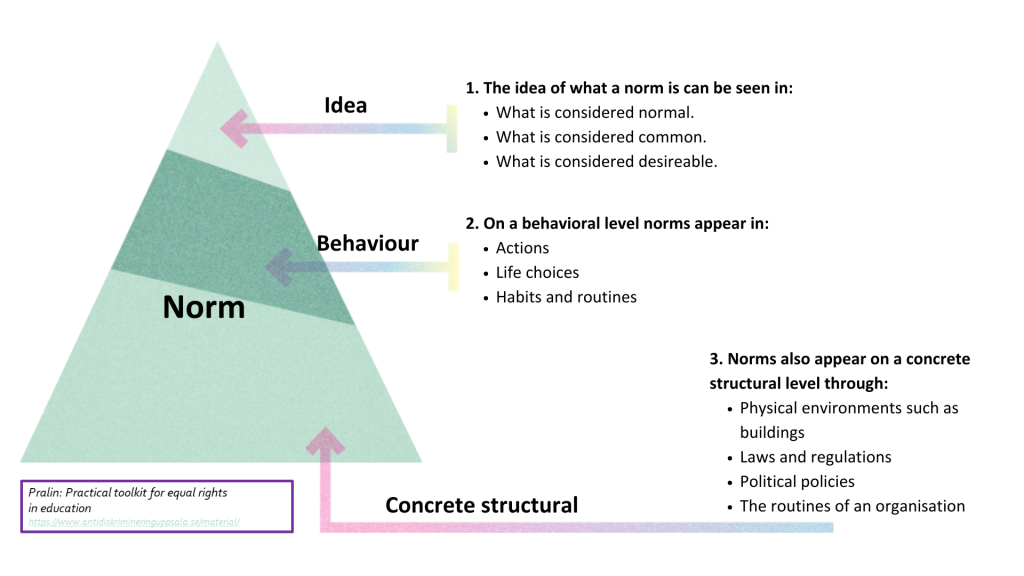
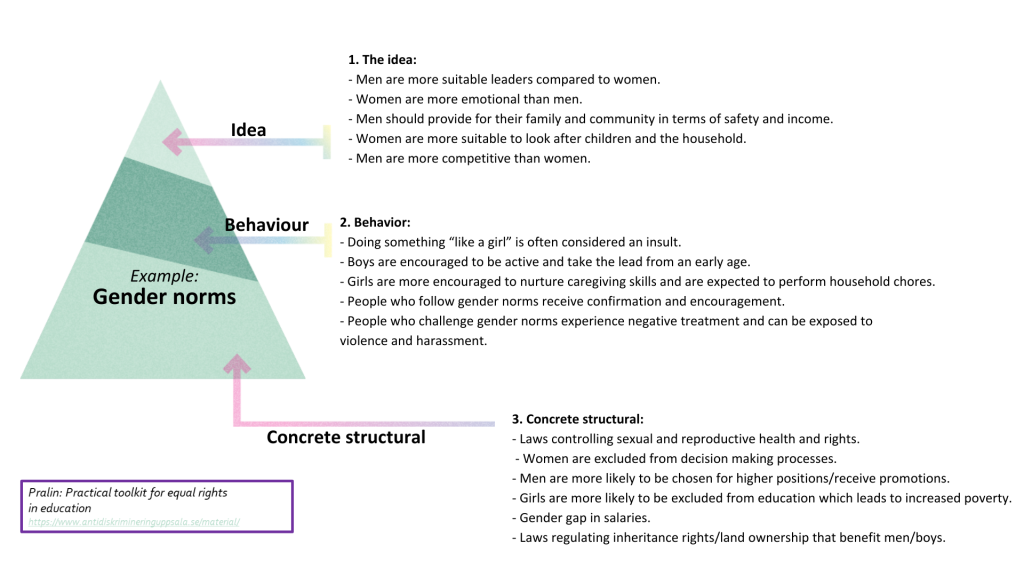
One way of understanding how norms are created is by breaking them down to three levels: one that deals with ideas, one that deals with behavior and one that deals with the concrete, and structural consequences that the norms have in society.
Example: The creation of gender norms

Intersectionality

Intersectionality is a sociological theory first coined by American civil rights advocate Kimberlé Crenshaw in 1989. Intersectionality refers to overlapping social identities and the related systems of oppression, domination and/or discrimination. The idea is that multiple identities intersect to create a whole that is different from the component identities.
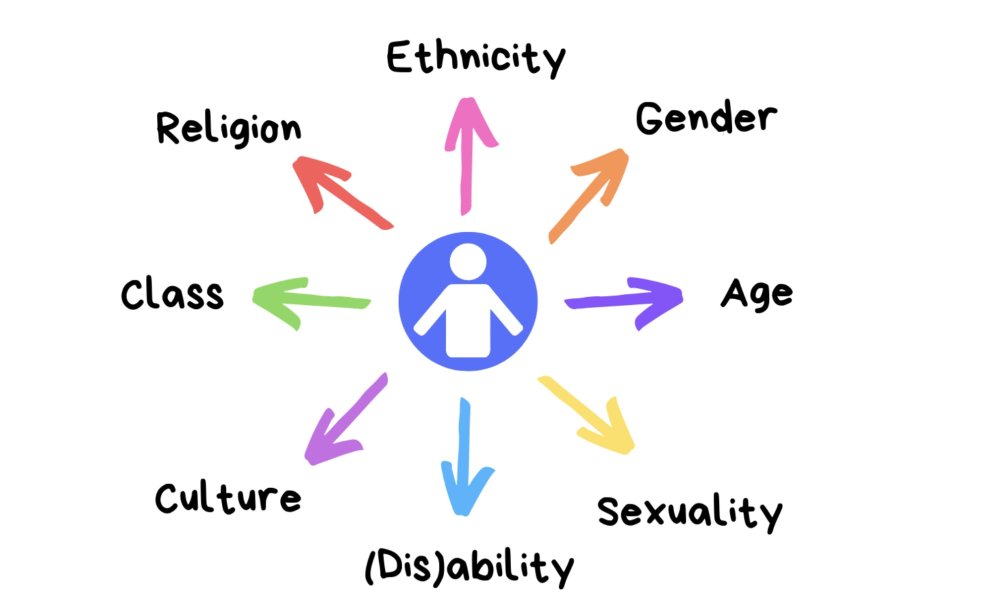
Having an intersectional perspective when working with gender equality is crucial because gender discrimination does not exist in a vacuum, but is intertwined with other factors such as race, ethnicity, class, sexuality, religion, and ability.

Do you want to learn more about intersectionality?

 “If you’re standing in the path of multiple forms of exclusion, you’re likely to get hit by both” – This TED-talk is presented by Kimberlé Crenshaw herself.

Key concepts: Gender, sex and identity
Prev
Module Reflection and facilitation
Next
Proudly powered by WordPress | Theme by: WP_Byrån.
Cookies
We serve cookies. If you think that's ok, just click "Accept all". You can also choose what kind of cookies you want by clicking "Settings". Read our cookie policy
Settings Accept all
Cookies
Choose what kind of cookies to accept. Your choice will be saved for one year. Read our cookie policy
  • Necessary
    These cookies are not optional. They are needed for the website to function.
  • Statistics
    In order for us to improve the website's functionality and structure, based on how the website is used.
  • Experience
    In order for our website to perform as well as possible during your visit. If you refuse these cookies, some functionality will disappear from the website.
  • Marketing
    By sharing your interests and behavior as you visit our site, you increase the chance of seeing personalized content and offers.
Save Accept all